
Redeemed Contracting · What to Expect
How Much Disruption Should You Expect During a Bathroom Remodel?
No sugar-coating — just an honest picture of what living through a bathroom remodel actually looks like.
If you're thinking about remodeling a bathroom, there's a good chance one question has been sitting in the back of your mind louder than the rest:
"How disruptive is this actually going to be to my daily life?"
It's the question we hear at almost every kitchen table we sit down at across Stark, Summit, and Portage counties. Homeowners want the new tile and the walk-in shower. What they're nervous about is the three or four weeks it takes to get there.
So let's talk about it honestly. We're not going to tell you a bathroom remodel is painless, because it isn't. But we will tell you exactly what to expect, where the rough spots are, and what a good contractor does to keep the disruption to a minimum. From the homes we've worked in around Hartville, North Canton, Green, and Hudson, we've learned that homeowners who know what's coming handle the process far better than the ones who get surprised.
Questions about your specific project?
We'll walk you through exactly what to expect — before the first wall comes down.
The Real Concerns
Why Homeowners Worry About Remodeling Disruption
Every concern you have about bathroom remodel disruption is reasonable. We mean that. None of these worries are silly, and any contractor who waves them off isn't being straight with you.
Losing access to the bathroom. A bathroom is one of the few rooms in the house you genuinely use every single day, multiple times a day. Take it offline for a few weeks and the whole household feels it.
Dust. People picture fine gray grit settling on every surface from the master bedroom to the kitchen counter. That fear is well-founded, because demolition does create dust, and without the right precautions it absolutely travels.
Noise. Demolition, tile saws, and hammer drills are loud, and if you work from home or have a baby napping down the hall, that matters.
Pets, kids, and schedules. Pets that get anxious or might bolt out an open door, kids whose routines get scrambled, work-from-home schedules that need quiet for calls — and the dreaded unexpected delays that push a project past the finish line you were promised.
If you've felt any of these, you're not being difficult. You're being normal. The goal of this article is to replace the vague dread with a clear picture.
Staying Home
Can You Live in Your Home During a Bathroom Remodel?
In the vast majority of cases, yes — you can absolutely stay in your home during a bathroom remodel. Most of our clients in Jackson Township and Uniontown never spend a night anywhere else.
How smooth that experience is mostly comes down to one thing: whether you have a second bathroom.
If your home has a second full or even half bath, living through a bathroom remodel is genuinely manageable. You lose a room, you adjust your routine, and life carries on. This is the most common scenario, and it's rarely a crisis.
If the bathroom under construction is the only bathroom in the home, the conversation changes. This is more common in older homes and smaller ranches around Akron and Canton than people expect. In that situation, a good contractor plans around your daily life. We can often keep the toilet functional for most of the project and only take it fully offline for short, scheduled windows. We talk through these gaps with you in advance so nobody is caught off guard at 6 a.m.
When a short hotel stay makes sense
The honest bottom line: living in your home during the project is the norm, not the exception. It's inconvenient, but it's livable — especially when the plan is laid out clearly before the first wall comes down.
The Hard Part
How Long Will I Be Without a Shower or Bathtub?
This is where we have to be careful not to sugarcoat, because the answer is longer than most homeowners hope.
For a full bathroom remodel, expect to be without that shower or tub for roughly two to three weeks, sometimes a little more. That's not because anyone is dragging their feet. It's because a quality remodel has steps that simply cannot be rushed.
Here's what's happening during that window:
Demolition — clears out the old fixtures, tile, and sometimes drywall.
Plumbing rough-ins — move or update the supply and drain lines behind the walls.
Electrical work — handles new lighting, outlets, fans, and any GFCI updates.
Waterproofing — seals the shower or tub area before any tile goes on.
Tile installation — sets the wall and floor tile.
Drying and cure times — the part people forget — thinset and grout need time to fully cure before the shower can take water and weight.
Fixtures and final trim — bring in the glass, the trim kit, and the finishing touches.
We'd rather give you one more day of inconvenience than a shower that fails in two years. A bathroom done right outlasts the wait.
Week by Week
What Does a Typical Bathroom Remodel Timeline Look Like?
No two projects are identical, but a full bathroom remodel timeline usually breaks down into about four weeks. Here's a realistic look at the bathroom renovation process so you can picture it.
Demo & Rough-Ins
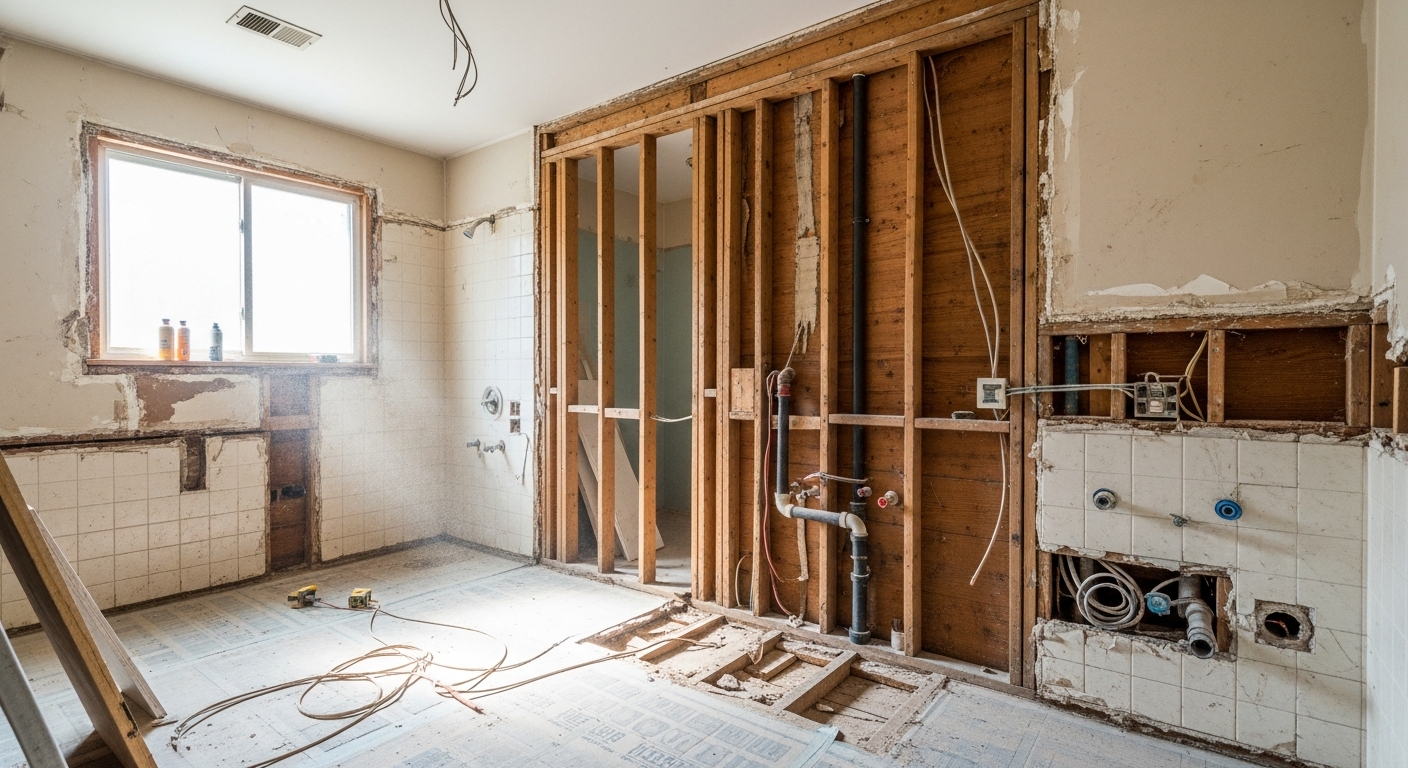
We start by protecting your home — floor coverings, dust barriers, and a clear path for the crew. Then comes demolition, the loudest and dustiest stretch of the whole job. Once the space is opened up, we handle any framing repairs that are needed and bring in the plumber and electrician for rough-ins. By the end of week one, the room looks worse than when we started. That's normal and expected.
Rebuild & Waterproofing
This is the rebuild phase. We install insulation, hang drywall, and complete the waterproofing in the wet areas. If your project requires permits — common for plumbing and electrical changes throughout Summit and Stark counties — we schedule inspection approvals before covering anything up. This week is quieter than week one but full of important, behind-the-walls work.
Tile & Flooring
Now it starts looking like a bathroom again. Tile installation goes in on the walls and floor, the shower gets built out, and flooring is set. Between tile and grout, we're also respecting those cure times, so there may be a day where it looks like nothing is happening even though a critical step is in progress.
Fixtures & Finish
The finish line. We set the vanity, install fixtures, hang the shower glass, handle paint, and work through the punch list — the small fixes and final details that separate a good job from a great one. This is the most satisfying week for everyone.
Custom tile adds time — and that's okay
Questions about your specific project?
We'll walk you through exactly what to expect — before the first wall comes down.
Dust Management
How Much Dust Should You Expect?
We'll be straight with you: a bathroom remodel creates dust. There's no honest way around it. Demolition dust is the heaviest, kicked up when old tile, drywall, and fixtures come out. Drywall dust from sanding is finer and floats further. And sawdust shows up during trim work near the end.
But here's the difference between a job done by professionals and a free-for-all: the dust is contained and managed, not left to drift through your home.
A good contractor uses:
Plastic containment barriers that seal off the work area from the rest of the house, often with zip-wall systems.
Floor protection running from the entry door all the way to the bathroom.
HEPA vacuums that capture the fine particles standard shop vacs miss.
Daily cleanup so dust and debris don't accumulate over the week.
Closing HVAC vents in the work zone when appropriate, so your furnace and AC don't pull dust through the whole duct system.
We'll be honest about the limit too: dust can never be eliminated entirely. Anyone who promises a 100% dust-free remodel is overselling. But with proper containment, the bathroom remodel dust stays where the work is, and the rest of your home stays livable.
Noise Levels
How Loud Is a Bathroom Remodel?
Volume varies a lot from day to day, and knowing the loud days ahead of time helps you plan.
The loudest stretch is demolition and tile removal — think hammers, pry bars, and the occasional thud of a cast-iron tub coming out. Framing can mean a circular saw and nail guns. Cutting tile runs a wet saw with a steady, grinding whine. And drilling into masonry or studs sends a sharp burst of noise through the house.
Then there are quiet days. Waterproofing, grouting, painting, and trim work are relatively peaceful.
Work from home? Tell us upfront.
Keeping Pets Safe
What About Pets?
Pets feel the disruption more than we sometimes realize, and keeping them safe and calm is something we take seriously. Dogs often get anxious with strangers and loud noises in the house, and an open exterior door during material runs is a real escape risk. Cats tend to hide, but a spooked cat can dart into the worst possible spot — like a freshly demoed bathroom with sharp debris.
Our practical advice:
Keep pets in a closed-off room or crate on the far side of the house, especially during demolition.
Let the crew know your pets are home and where they are, so doors stay closed and gates stay latched.
On the loudest days, consider doggy daycare or having a friend in Hudson or Hartville take them for a few hours.
Watch for noise anxiety — some pets pace, pant, or stop eating. A quiet space with a familiar blanket helps.
A good crew will respect your routine and double-check doors. But the safest setup is a clear plan you and the contractor agree on before work starts.
Utilities During the Project
What Happens to Water, Plumbing, and Electricity?
This is a worry that's usually bigger in homeowners' minds than it turns out to be in reality, because almost everything here is planned and communicated in advance.
Short-term water shutoffs. These happen, but they're scheduled. When the plumber needs to tie into your lines, we may shut off water to part or all of the house for a few hours. You'll know the day before, not the moment your faucet runs dry.
Temporary plumbing interruptions. The bathroom's water and drains are offline during the rough-in and tile phases. If it's your only bathroom, we work to keep the toilet usable as long as possible and minimize the gaps.
Electrical shutdowns. Usually brief and limited to the circuits we're working on. The rest of your home keeps power.
A good contractor never leaves you guessing about when the water or power will be off. If you ever find yourself surprised by a shutoff, that's a communication failure, not an unavoidable part of the process.
Understanding Delays
What Causes Bathroom Remodel Delays?
Delays are the part homeowners fear most, so let's be honest about why they happen — and why they're more common in our area than in newer parts of the country.
The most frequent culprits:
Hidden water damage behind walls or under floors, often from a slow leak that went unnoticed for years.
Mold discovery once the walls come open, which has to be remediated properly before we rebuild.
Structural issues like rotted subfloor or compromised framing.
Material backorders on tile, vanities, or fixtures.
Change orders when you decide mid-project to upgrade something or shift the layout.
Specialty products — custom glass, imported tile, or made-to-order vanities — that simply take time to arrive.
Inspection scheduling that depends on the municipality's calendar, not ours.
Why older Northeast Ohio homes see more surprises
The goal isn't to promise zero surprises — that's not realistic in old homes. The goal is to handle the surprises calmly, explain your options, and keep you informed.
What Sets Good Contractors Apart
How Good Contractors Reduce Disruption
After all of this, here's the encouraging part: the difference between a stressful remodel and a smooth one usually isn't the size of the project. It's how the contractor runs the job.
The practices that actually reduce disruption:
Clear communication — a real conversation at the start and consistent updates throughout.
Daily cleanup so the work zone never spirals into chaos.
Thorough site protection for floors, walls, and the path through your home.
Scheduling trades properly so the plumber, electrician, and tile setter show up in the right order without dead days.
Ordering materials early so a backordered vanity doesn't stall week four.
Providing realistic timelines instead of telling you what you want to hear.
Communication is often more important than speed. A homeowner who gets a quick update each evening will feel far less disrupted than one whose project finishes a few days faster but who spent every morning wondering what was going on.
Before You Hire
Questions You Should Ask Before Hiring a Bathroom Remodeling Contractor
Before you sign anything, sit down with your contractor and ask these directly. The answers tell you a lot about how your project will actually go.
How will you protect my home? Listen for specifics like containment barriers, floor protection, and HEPA vacuums.
What is your cleanup process? Daily cleanup should be standard, not a special request.
How often will I receive updates, and how? Text, call, email — and how frequently.
What happens if hidden issues are found? A good contractor explains their change-order process up front.
What timeline should I realistically expect? Be wary of anyone promising an unusually fast finish.
Who will be in my home each day? You should know whether it's the same trusted crew or a rotating cast.
If a contractor gets defensive about any of these, that's useful information.
FAQ
Frequently Asked Questions
Can I use my toilet during a bathroom remodel?
How long will I be without a shower?
How dusty is a bathroom renovation?
Can I work from home during remodeling?
Will my water be shut off every day?
What if hidden damage is found?
How long does tile installation take?
Can pets stay home during the project?
Do bathroom remodels usually run late?
How can I prepare my house before construction starts?
The Bottom Line
What to Expect — Honestly
Let's be honest with each other: a bathroom remodel is disruptive. For a few weeks, you'll lose a room, hear some noise, see some dust, and adjust your routine. We're not going to pretend otherwise.
But here's the part worth holding onto — you should not be afraid of the process. The disruption is temporary, it's manageable, and the vast majority of homeowners across Stark, Summit, and Portage counties live in their homes the entire time and come out the other side with a bathroom they love.
The single biggest factor in how stressful it feels isn't the dust or the timeline. It's whether you knew what to expect and whether your contractor kept you informed. Good planning, realistic expectations, and strong communication turn a daunting project into a predictable one.
Hartville · Uniontown · North Canton · Green · Jackson Township · Hudson · Akron · Canton
Let's Walk Through Your Project Before Construction Starts
At Redeemed Contracting, we believe you deserve to know exactly what to expect before the first wall comes down — the inconveniences and all. Reach out to us and we'll sit down together, walk through your project, your timeline, and your questions, before construction ever begins.
No pressure, no sales pitch. Just an honest conversation.